
01 Security
A solid, engineered site perimeter that keeps the site closed and controlled.
For all that time it is the only part of the development the city actually sees — and almost nobody designs it.
A construction hoarding built from tempered architectural glass and printed with ceramic ink. It protects the site, carries the identity of the project and turns the site perimeter into a designed surface.
Tempered glass · Ceramic ink print · Modular, reusable panels
A solid, engineered site perimeter that keeps the site closed and controlled.

The architecture of the project reads on the street before the first floor is poured.

A continuous branded surface in front of thousands of people every day.

A glass hoarding is bought once and carried from site to site. Over a development cycle it costs less per project than a printed banner replaced every season.
One panel set moves from one site to the next
Ceramic ink does not fade, peel or scratch off
Continuous contact along the full site perimeter
*Reuse applies to panels produced in a universal, project-neutral design. Site-specific artwork is printed again for each project.
WE WALL SOLUTIONS is an architectural assembly, not a banner stretched over a temporary barrier.
Panels are specified as toughened, impact-resistant glazing for public frontage.
The site perimeter is designed for high wind loading on exposed Dubai plots.
The system is set out to meet Civil Defence and UAE municipal requirements.
Holds its finish through summer heat above 50°C, airborne dust and coastal air.
Ceramic ink becomes part of the surface — it is not a film applied on top.
Scheduled washing and upkeep of appearance are provided as a paid service.
Panels move from site to site. The artwork changes, the glass stays.
Delivered projects — printed architectural glass hoarding


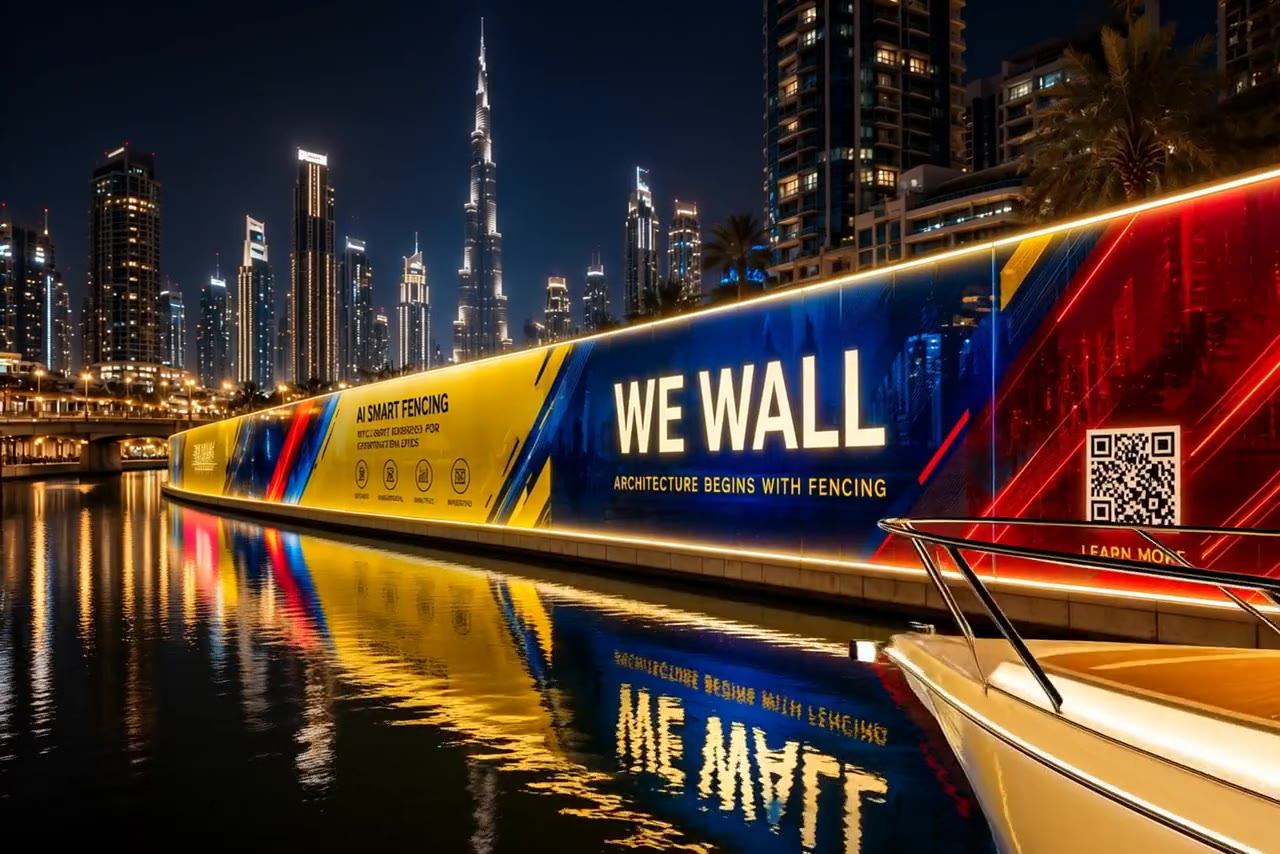
Ceramic inks are fired into the glass itself rather than laminated on top, so the image becomes part of the surface — it does not peel, scratch off or fade in the sun. Cutting, tempering and digital printing all run on automated industrial lines.
Automated cutting, tempering and digital printing lines
Glass is cut and edged to the panel layout of the perimeter.
The project artwork is printed digitally with ceramic ink.
Tempering turns the panel into safety glass and fuses the ink into its surface.
Panels go up in sequence along the site boundary, so one image runs across the whole wall.
A passer-by scans the code on the panel and starts a conversation. The assistant answers questions about the development in any language, at any hour — and hands a warm lead to the sales team.
A QR code on the glass opens the assistant — no app, no download.
It explains layouts, timelines, pricing and location in the visitor's own language.
Name, phone and stated interest are collected inside the conversation.
The brochure is sent instantly and the lead lands in the developer's CRM.
Film is laminated onto the surface and can peel, fade and discolour under UV. WE WALL uses ceramic ink fired into the glass, so the print becomes part of the panel.
The panels are tempered safety glass. Ask for the technical specification when you request a proposal.
Yes. Artwork is printed for each project, so the hoarding can carry the project's renders, name and sales message.
Yes. Panels can be lit from inside so the print stays readable after dark.
Price and lead time depend on the perimeter length, the design and the location. Send the site details and we will prepare a proposal.
Yes, in two ways. The AI consultant lets a passer-by scan a QR code and ask questions about the development. The optional AI module can add access control, perimeter monitoring and traffic analytics. Both are specified per project.
Dubai and the wider UAE. WE WALL hoarding already stands in Tashkent, and we also deliver projects for developers in Russia.
A pilot section of the perimeter is the usual next step.
One elevation, one artwork, installed on a live site.
Each proposal is built around the perimeter, the design and the location.